Catch the contradiction while they're still talking.
Predictive Law listens to your hearing or deposition, checks what the other side says against your case record, and shows you the page that proves them wrong, seconds after they say it.
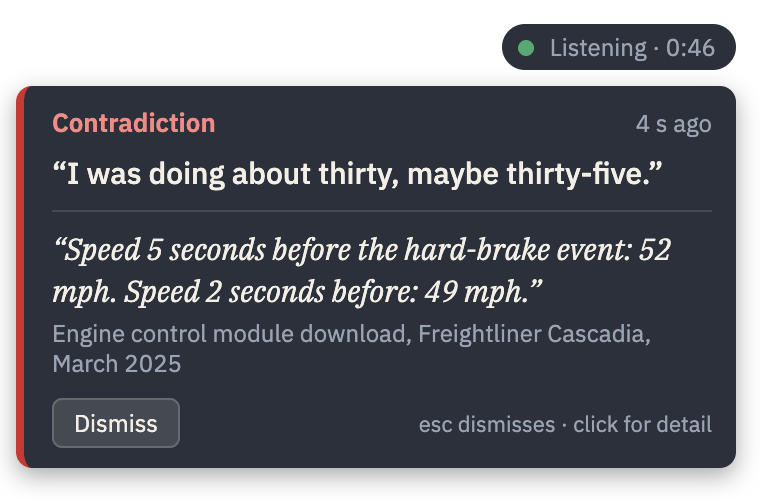
Fictional case. The card is a real screenshot of what Predictive Law showed.
They said it on the record. Your file says otherwise.
You don't have the entire case file in your head while a witness or opposing counsel is talking. Predictive Law does, and it tells you which page.
- Q. What color was the light when you
- entered the intersection?
- A. It was yellow when I went through.
- Q. Were you using your phone in the minutes
- before the collision?
- A. No. My phone was in the cup holder. I
- wasn't texting or anything like that.
- Q. Did you call anyone after the crash?
- A. I called 911 right away.
How it works
Load the case before the hearing. Join the call the way you always do. Predictive Law runs from your menu bar and stays quiet until the record disagrees.
Load the case
Medical records, prior testimony, police reports, discovery responses. Predictive Law reads the case file before the hearing starts.
Listen
It hears the call through your computer's audio, on Zoom, Teams, Meet, or anything else. No bot joins the meeting. Each thing the other side says is checked against the whole case file.
Cite
When the record disagrees, a card shows what they said, what the record says, and the source. You decide whether to use it.
Share your screen. They won't see it.
The cards are excluded from screen sharing and recording.
Built for privileged material.
Audio stays on your computer
Speech is transcribed on your machine. Predictive Law doesn't save the audio and doesn't join the call.
Only text is checked
The other side's statements and your case file either stay on your computer or are processed in a HIPAA-compliant manner.
You make the call
Every card cites its source so you can read it before you use it. Predictive Law flags. It never speaks for you.
About
I co-founded Litify and spent years building software for law firms. The tools I'm proudest of did one specific job well, at the moment a lawyer needed it.
Witnesses lie. Opposing counsel stretches the facts. People contradict their own records, and what they swore to six months ago. The proof is almost always in the case file, but nobody can search the case file while someone is talking. If you're lucky, you find it weeks later in the transcript, after the chance to confront them has passed. Often nobody finds it at all. With today's models, finding it in seconds is a solvable problem. So I built Predictive Law.
Noah BlumenthalFounder, Predictive Law · noah@predictivelaw.com
Hear the next misstatement as it happens.
Questions? Email noah@predictivelaw.com.